Thursday, March 31, 2022

Pond Work Completed Just in Time for Spring Rains

 Ski Lake Spillway Renovation

The spillway pipe structure on Ski Lake (#1 Pond Farm Course) has been successfully replaced.  The original Galvanized pipe had deteriorated to the point if could no longer be trusted on what is the club's only high hazard dam.  The project has been in the works for several years with the permitting process taking well over a year for the approval of our engineered plans.  The pond had to be dropped over 10 feet to conduct the new construction work.  Once the work began it went very smoothly and finished on time despite a few heavy rains slowing us down.  The work is now officially over and moving forward  we just a need a few good rains to get the pond back to an acceptable water level before we start using it again for our course irrigation.


Farm #14 Pond Level

Our repair of the spillway structure last year resulted in the wrong final elevation of the pond level.  This was due to leakage in the pipe over a long period of time, which gave us a faulty survey reading of the true lake level.  As such, a new riser was added to the new system this year at no additional cost to the club to bring the lake water height up to it's proper level.  The pond on #14 had to be lowered several feet to add the extended structure, but that work is now complete and we expect once the pond is full this addition will result in a much more attractive pond and a lot more water, which is important as this pond also serves as a primary irrigation source.


Additional Storm Drainage #11 Farm

Water flow from the additional road widening on Horsepen Creek road has added to our storm flow demand on the left side of #11.  This actually has always been a problem going back the 2009 renovation but the roadwork definitely added additional storm flow and siltation.  We have hopefully alleviated this problem by catching the the water as it comes onto the golf course and not allowing it to travel all the way to the singular basin in the low area at the turn of the dogleg.


Preparing for the Spring/Summer Season

Both courses have received preventative treatments for spring and summer weeds.  Both courses are now working on installing mulch in all our landscaped areas.  In total the staff will put over nearly 1500 yards of hardwood mulch between the two courses.  Nearly 3,000 bales of pinestraw will follow this in May.  The Irving Park greens were aerified in early March and are now nearly 100% recovered.  The Irving Park staff recently completed the large task of adding nearly 200 tons of replenishment sand to the bunkers.  Of course all this work and much more is done in conjunction with routine maintenance of the two courses for daily play.


Irving Park Range Renovation  - Tentatively Start Repairs May 2

We are tentatively scheduled to begin putting the Irving Park back together on May 2nd.  This of course is very dependent on the clubhouse contractor completing enough of his work, so that he can get range area cleared of trucks and materials.  Once the work does begin we expect the renovation work to last approximately 6-8 weeks.  The scope of the project currently includes redoing everything from the first tee to the practice green to restoring the range area.  Everything will be put back together very similar to what is was before construction damage with the exception of the practice green which we expect to be significantly larger and more usable.  

Thursday, November 4, 2021

Fall Golf On GCC's Courses

 Leaves and More Leaves


You can't discuss fall golf without mentioning leaves.  Despite the mild weather thus far this season the leaves have finally began falling and keeping up with them is no small task for the guys on the crew.  We will dedicate 80-90% of our manpower over the next 8-10 weeks trying our best to keep the course as clean as possible.  There of course will be days where we lose the battle, but whenever we fall behind just know we will work extra hard to catch up all in an effort to make everyone's golf experience as enjoyable as possible.  

Frost Delays

Fall is also the time where early morning tee times are often delayed by the formation of frost.  Golf course turf is normally resilient to traffic, but when ice crystals form inside the plants, they become brittle and vulnerable to damage. Walking or driving over frost-covered grass may rupture plant cells, leading to dead turf. Or the plants may be weakened without immediately showing the effects. When this does occur the golf maintenance team will work closely with the Pro Shop staff to communicate the length of the expected delay to the membership. Golfers should be aware that when temperatures are forecasted to be within 2-3 degrees, or lower. of freezing frost is possible.  The later we get into winter the colder the soil temperature becomes, which typically results in longer delays..


Fall Overseeding and Minor Repairs to the Cool Season Turf


Above - A long overdue repair of turf underneath the large hardwoods on Farm #6 dogleg
                                                                           

Irving Park #7 Right Side Convert Mulch to Grass


We Have Also Been Working On A Few Landscaping Projects

New Hollies on #16

#15 IP


First Phase Landscaping Starting at Clubhouse

Uninvited Guest

I know many of you that live around the course have seen our unwanted guest this year.  I have been in the business for a good number of years and seen all kinds of wildlife on the course and more importantly how some of that wildlife affects the course.  Geese have historically been our biggest nuisance when they choose to feed on the greens and leave behind the spoils of their feeding.  Deer can occasionally damage greens and their winter feeding habits will certainly defoliate plants they seem to enjoy.  Groundhogs and musk rats cause their fair share of damage along creek and lake banks.  Crows occasionally damage the turf while feeding on worms and grubs.  I've seen beavers cause flooding on a scale I couldn't believe was possible.  

But the guest I am talking about is our neighborhood fox or foxes, I really don't know how many.  For well over a year now we have seen damage to our greens and bunkers on what is a nearly daily occurrence.  Damage ranges anywhere from scratching the surface on the greens and bunkers to digging holes large enough to sleep in.  They seem to like the greens and bunkers because they are easy to dig in.  We have even had, during the middle of the day, a fox walk across the fairway and steal one of the members balls.  This summer we had to use part of our Bentgrass nursery to allow us to constantly be plugging out the damage on the greens and when we went to re-seeded the nursery this fall it didn't take long for the newly seeded area to be destroyed by that same animal.  We've treated some of the areas with hot pepper spices but it only seemed to work for a few days and when we put it on the greens it burned the leaves.  We did hire a wildlife expert to come in and attempt to trap and relocate but after a month or more of traps being set around the course and a lot of invoices for their services we never had one single trap set.  So, not only is he/she destructive but he/she is fairly smart too.


A few Pictures out of 100+ I could have taken


Thursday, August 19, 2021

Final Greens Aerification of the Year

Next Monday-Tuesday (8/23-8/24) we will undertake our final greens aerification on the Irving Park course.  


Aerification is an important cultural practice. Through aerification we; 1) extract excessive accumulation of organic material; 2) improve soil gas exchange; 3) stimulate new root development; 4) stimulate microbial activity; and 5) improve the plants ability to withstand biotic and abiotic stresses.

Having said that, there are still plenty of golfer skeptics! Aerification is one of the most despised cultural practices when it comes to the golfer as it disrupts the playing surface; is usually done during the prime playing seasons; and according to most golfers has no redeeming features other than to decrease green performance and raise one's golf score. On the other hand, aerification is likely the most important cultural practice that a turf manager can perform. Why? Simply put to maintain a root system under the target plant. The plant's response is to maintain density enabling it to tolerate traffic, and resist ball marking; maintain a deep effective root system to withstand limitations on water quantity and water quality; and to maintain healthy plant growth to tolerate biotic and abiotic stresses. 

Bermuda Versus Bent

The biggest difference is Bentgrass, being a cool season grass, grows best during the spring and fall months.  On the other hand, Bermuda is a warm season grass that grows best during the summer months.  Ideally we seek to annually achieve organic matter removal in the 15%-20% range of the total surface area for highly manicured surfaces such as golf course greens.  We also schedule aerification either during or just prior to ideal growing conditions to enable the plant to take full advantage of the process and to maximize recovery time.

Bermudagrass is a much tougher plant than Bentgrass and can withstand a much more aggressive aerification process than its Bentgrass counter part.  So with only one true growing season for Bermudagrass and it being a tougher plant we only schedule one aerification on the Bermuda where we aggressively verticut the entire surface multiple times over and then double aerify the green, effectively seeking to hit our goal of surface disruption (organic matter removal) all in one shot.  

Bentgrass is a somewhat more delicate plant with three completely different growing seasons.  Each time we aerify the Bentgrass we use a somewhat less aggressive level of surface disruption where the cumulative effect of our three aerifications adds up to the 15%-20% goal.

Total Full Recovery time following an aerification procedure:

Bermudagrass - 5 weeks

Bentgrass - 4 weeks x 3 = 12 weeks


Thursday, July 8, 2021

Farm Course Closed for Aerification Week of July 12-16 
Irving Park Course Closed July 19 - 21 for Fairway Verticutting
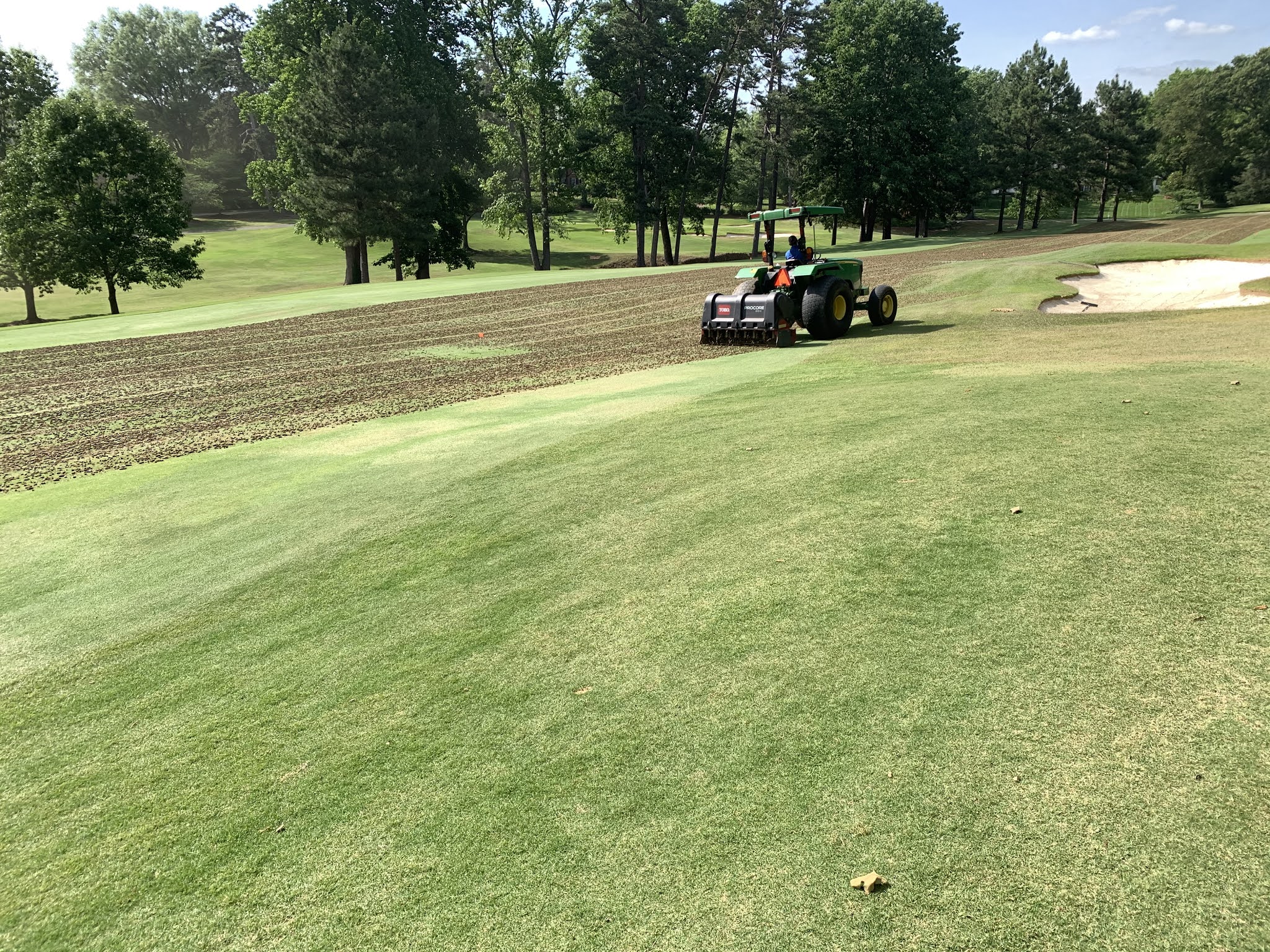
As with any large scale aerification procedure our objective next week will be to remove and manage excess organic matter. Organic matter is a combination of living and dead plant material found in soil – e.g., roots and stems. While some organic matter is good, especially living organic matter, high levels of dead organic matter can cause problems. The water-holding capacity of organic matter in most mature turf is almost five times more than the water-holding capacity of sand. When heavy or prolonged rain events occur, soils with high levels of organic matter will hold water longer and are slower to drain. This in turn makes for softer greens, fairways, tees and roughs. Wet areas that are slow to drain will restrict cart traffic and impede maintenance activities like mowing. Wet areas are also much more prone to diseases that can lead to turfgrass thinning or loss. When the pore space of soil is filled with water instead of air, roots will suffer. Roots need oxygen and if they die, the turfgrass will die. So, continued removal of organic matter is necessary. When we aerify the greens sand topdressing helps to dilute what is not removed while facilitating drainage and delivery of oxygen to roots. Balancing the water-holding capacity of a soil by incorporating sand gives the grass access to both water and air within the soil, and creates a firmer playing surface. Sand enhances playability in addition to diluting organic matter.


New Forward Tee Constructed on Farm #7
A new forward tee was recently constructed and sodded on the 7th hole on the Farm course.  The new tee will measure approximately 340 yards.  The 9th and 12th holes are the only remaining holes where the tees are in place but a teeing area has not been constructed.


Drainage
The staff on both courses have been busy installing new drainage this year.  The farm course has added drainage on holes #2, #5, #6, #13 and are currently working on a small spot on #4.  The Irving Park staff re-did an extensive amount of drainage on the #7 fairway and added additional drainage to the upper end of the fairway.


Sod Work
The staff has finished with the bulk of the sod work required for the year  on both courses.  in regards to early summer turf repairs this year's quantity was very average with no winter kill related repairs.  This year was a little unique in that we lost a measurable amount of Zoysia sod this year due to a very wet 2020 fall and 2020-2021 winter.  One of Zoysia's biggest weaknesses is that it has a very low tolerance to prolonged saturated conditions, especially during the winter months.  2020 was the second wettest year on record for our area, so some of the larger areas of dead turf we witnessed this spring in our low lying Zoysia areas was not unexpected.  Another thing that was unique was the cooler spring and early summer lead to a big delay in when the Zoysia was made available from our suppliers and that is why some areas didn't get sodded until July this year.


Friday, March 19, 2021

Spring Officially Arrives this Weekend and with it comes Another Weekend With Wet Playing Conditions


Storm storms passed through the area Thursday night but it could have been worse.  Tornadic winds were reported in the southern part of the county, so despite all our Irving Park bunkers completely washing we are very grateful we didn't arrive to a course with trees and limbs scattered across the property.  Unfortunately the guys will be working extra hard today trying to get the bunkers playable for the weekend and it looks like with another 1.5 inches of rain carts will be on the path once again, but what's new.

 Speaking of bunkers, the staff devoted a lot of time this winter adding new sand to the bunkers on both courses.  Over 200 tons of new sand was added to bunkers throughout both courses in an effort to get the sand levels back to the proper depth.  Nearly two thirds of the sand was devoted to the Irving Park course where the washing nature of these bunkers has resulted in not only lost sand but a sand that is heavily contaminated with fines that erode off the washed out clay bunker faces. The new sand will greatly improve the playability of these bunkers.


  • #2 IP Fairway Bunker with New Sand

Greens Aerification

The Irving Park greens were aerified on March 1&2.  Our early spring aerification is the slowest one to recover due to the cool soil temperatures that exist for this time of the year.  While we experienced a very nice period of weather last week we are still not expecting the greens to be fully recovered until the last week of March.

Once we get into a prolonged warmer period that results in consistent new warm season grass growth we will also needle tine the Ultradwarf greens on the Farm course in an effort to unseal the surface of these greens after a long winter.  The effects of a needle tine aerification only last a few days and are barely noticeable to the average golfer.  We expect this will occur sometime in early April if weather patterns are near normal for the next few weeks. 

 Bermudagrass Transition

 While the winter has been exceedingly wet the temperatures have been near normal and as such we are currently expecting a good spring transition on all our warm season grasses.  Due to their wet nature and the warm week we experienced last week the Irving Park fairways are already trying to break out of dormancy.  The temperatures are expected to drop below freezing this weekend (31 degrees), so begins the back and forth nature of Bermudagrass transitions in our region.  We do expect tonight's below freezing temperatures to knock the new growth back a little, but ultimately temperatures that hoover right around freezing will not hurt the Bermuda or Zoysia.


#1 IP Fairway Breaking Dormancy Mid-March


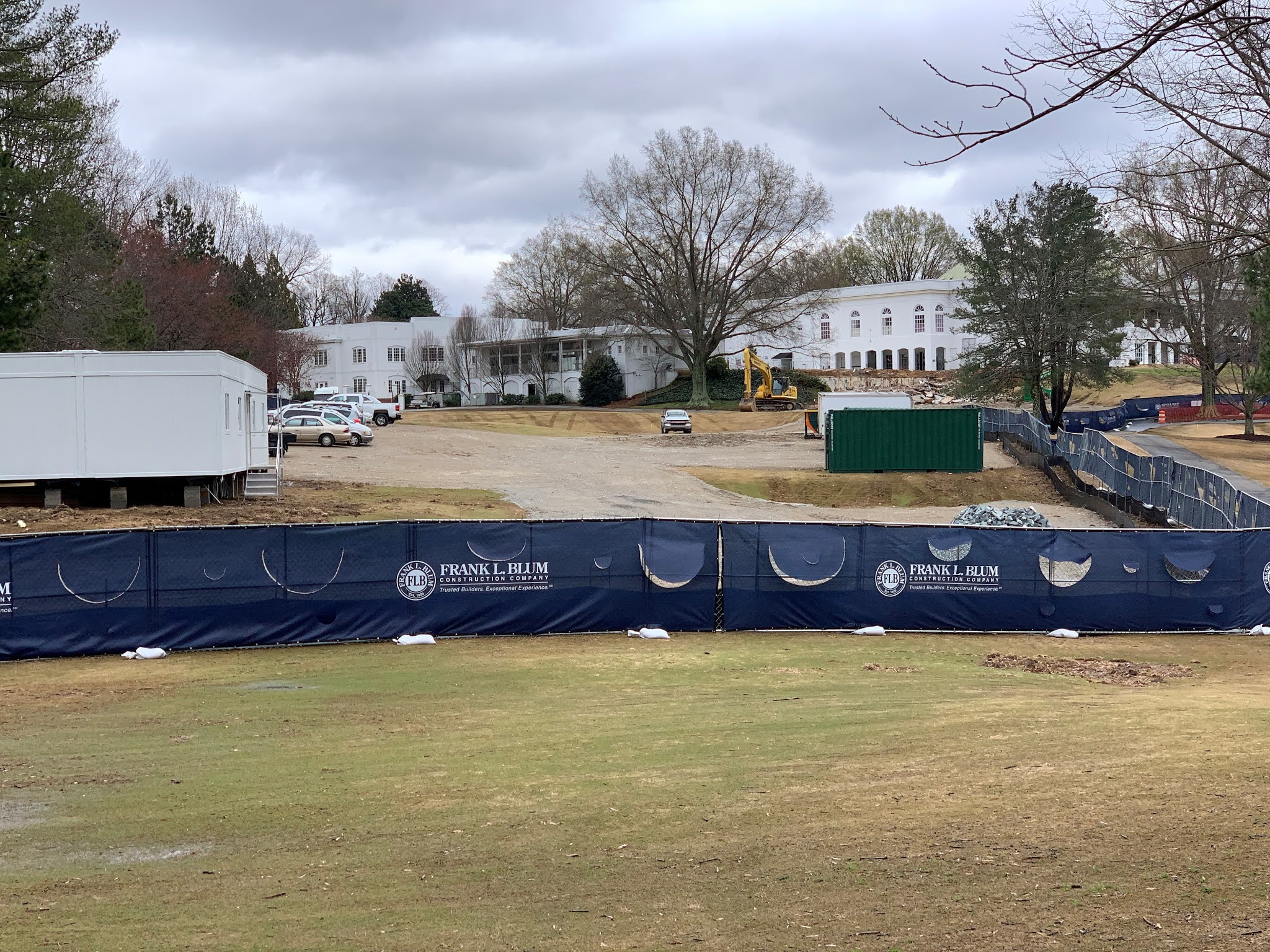
 Irving Park Pool, Clubhouse and Fitness Renovation

As everyone knows by now the IP renovation project is now in motion.  The project will have multiple effects with golf on the IP campus:

  • The practice area, including the practice green, will be closed throughout the duration of the project
  • Golfers playing 17 and 18 will need to be aware of construction traffic crossing these holes. 

  • Golfers finishing on #18 will need to return to the clubhouse by crossing 18 fairway and proceeding to the left of the green.  From there they will need to proceed toward #16 and return to the clubhouse via Granville Rd or #16 tee if play is slow and no one is playing the hole.  The cart path at #16 tee is not wide enough to handle two-way traffic.  We do expect worn, damaged and muddy areas to develop along this avenue over the next year and will work to repair these areas in a timely fashion.

  • The staging area for the project encompasses the majority of the range and significant time was spent lowering sprinkler heads, removing sprinkler heads, relocating irrigation controllers to allow for the gravel surface and/or the expansion of the clubhouse footprint.  The board is currently reviewing the extent of changes necessary to restore this area once the project concludes in the spring 2022. 


Saturday, July 11, 2020

July Courses Update


Summer is always a busy season for golf course maintenance and this year is no different.  Between cultural maintenance projects, improvement projects and basic maintenance the staff has a really long list of things to do every day with little time for rest.  Below are a just a few things we've been working on as of late.

Hand Watering Alert!

The full heat of summer is upon us and with that comes daily hand watering of the Bentgrass greens on the Irving Park course.  Bentgrass is a cool season grass that requires a lot of extra TLC throughout the summer months.  The later we get into the summer season the closer attention these delicate putting surfaces require.  On average we use the overhead irrigation system on the greens every 4 or 5 days to allow the greens to dry out in-between cycles.  This process helps to reduce disease pressure associated with hot, wet conditions.  On the days between these watering cycles we hand water certain areas of the green that dry out quicker than others on an almost daily basis in the morning.  The afternoon watering sessions are used to lightly water the surfaces to cool down the plant by aiding the plant's natural respiration defense mechanism.  On most days we are able to do these afternoon cooling cycles in and around play with little disruption to the golfers.  But, there are always those days when the volume of play and the wilt factor are both high and the staff has little choice but to disrupt play with their cool downs.  Golfers are known to be an impatient group of people and conflict can result.  If you find yourself on the course on one of these days please respect the safety of the staff by waiting until they are finish with their cooling down process.  The staff are trained to stay out of the golfers way but sometimes that simply is not possible.  In the end, they are just working hard in an effort to keep the greens alive and healthy and waiting will have little effect on when you finish your round, because if it is busy enough for our staff to interrupt you then most likely you will catch back up to the group in front of you on the very next hole. 

Syringing Bent


14 Spillway Pipe Repair

The spillway pipe repair project is a little over half way through and the high risks part of the project has been completed.  The old pipe has been slip lined with a new pipe.  Grout has been pump in between the old and new pipe to ensure there is no seepage that could result in erosion issues undeath the dam structure.  The new concrete riser structures are currently in the process of being installed and the last part of the project will be the earthwork to repair the damage done to the dam itself from the project and the earlier erosion related to the faulty pipe.  Weather permitting, we hope to conclude this project by July 28 when we will begin pumping water from our wells and hope for natural rainfall to begin to slowly refill the pond.  We do not expect the pond will be completely refilled until sometime late fall-early winter, unless we run into a really wet period.

Excavating down to original pipe
    
Installing Riser


Tee Box Renovation on IP #1

With the large Oak tree no longer shading this area we felt it was a good time to renovate the existing tee and take advantage of the missing tree to add some additional tee space.  The old tee was poorly constructed with a very uneven and shallow layer of mix, so 60 yards of new mix were brought in to increase the depth of the growing media and to help shape out the new teeing area.  The tee was sodded with Zeon Zoysia and should be ready for play next weekend (7/18).

New Soil Brought in for New Teeing Area

New Mix Added to Entire Teeing Area

#1 Sodded

Cultural Maintenance

The Farm course was aerified in late June this year and the recovery period has been going very well despite the drought as of late.  Tees, fairways, greens and closely mown green surrounds were all on the hit list in what is most likely the most grueling week of the year for the staff.  New drainage was recently added to #2 fairway with additional drainage planned for holes 16 and 18.

The Irving Park course fairways were recently vertically mown in an effort to remove some of the surface thatch and the grain that comes with closely mown Bermuda.  We also used this time to solid tine or vent the Bentgrass greens, which are doing well for this time of the year, but the toughest growing season comes over the next 6-8 weeks, so stayed tuned as we continue to work hard to keep them alive and healthy and rolling consistently.

Busting Plugs - By Far the Worst Job Ever

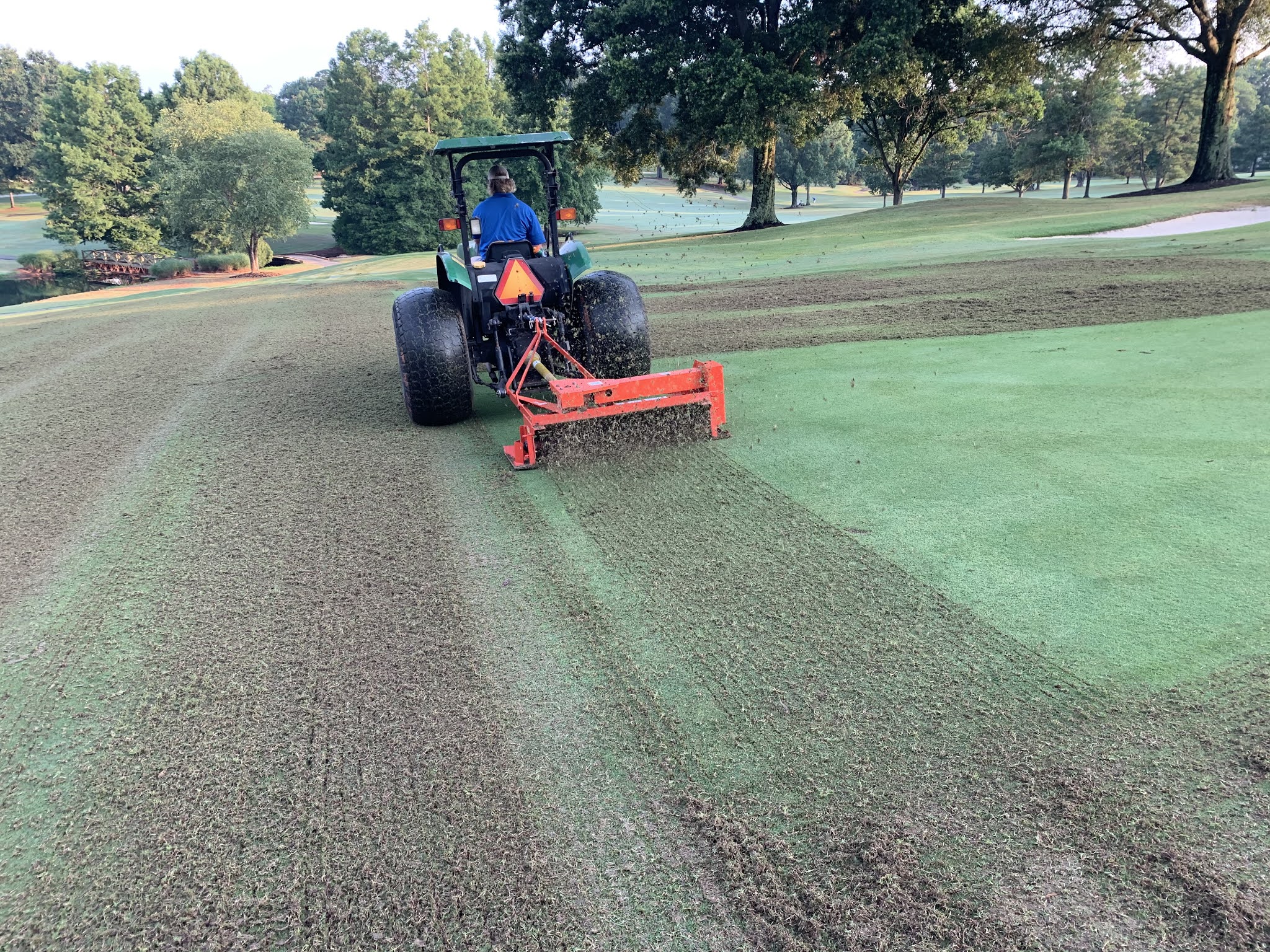
Aerifying Farm Fairways

Verticutting IP Fairways

New French drainage #2 Farm


Farm Hole #11 Dogleg

Brooks and the staff recently completed a nice improvement project on the eleventh hole of the Farm.  The left corner at the dogleg had been in very rough condition for some time now.  Trees, poor soil, erosion and a lack of irrigation all made this area nearly impossible to grow healthy turf.  Last fall several trees were removed from this area to allow for increased sunlight, which was the first important step in renovating this area.  The next steps included adding addition irrigation, storm swales to redirect water and a lot of new topsoil were all added to the area.  The final touch was installing a large amount of Zoysiagrass to the area.  This was one of the last out of the way, but in-play areas, on the course that has been on our list for several years but has now been checked off.


#11 New Soil & Irrigation
#11 Sodded